
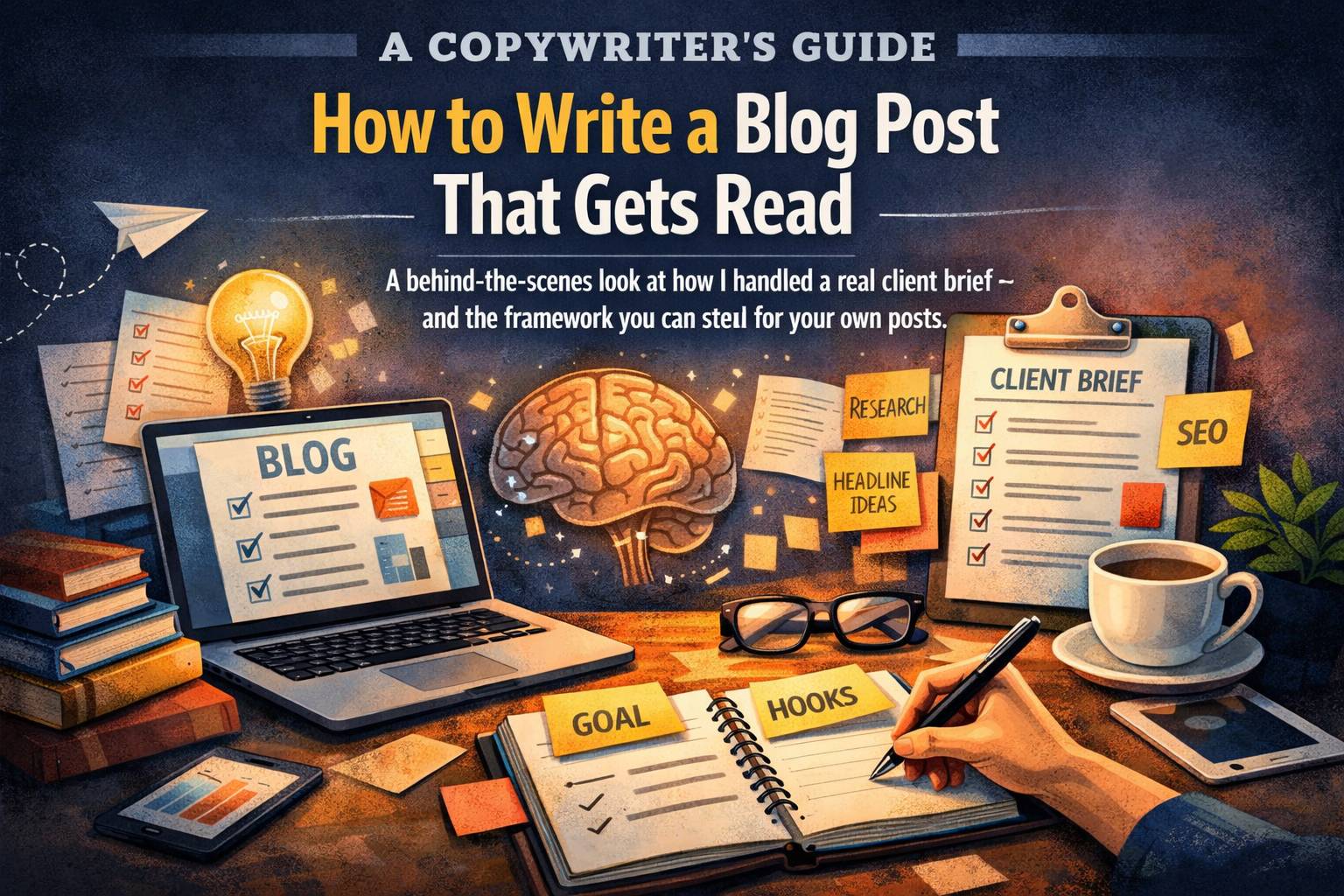
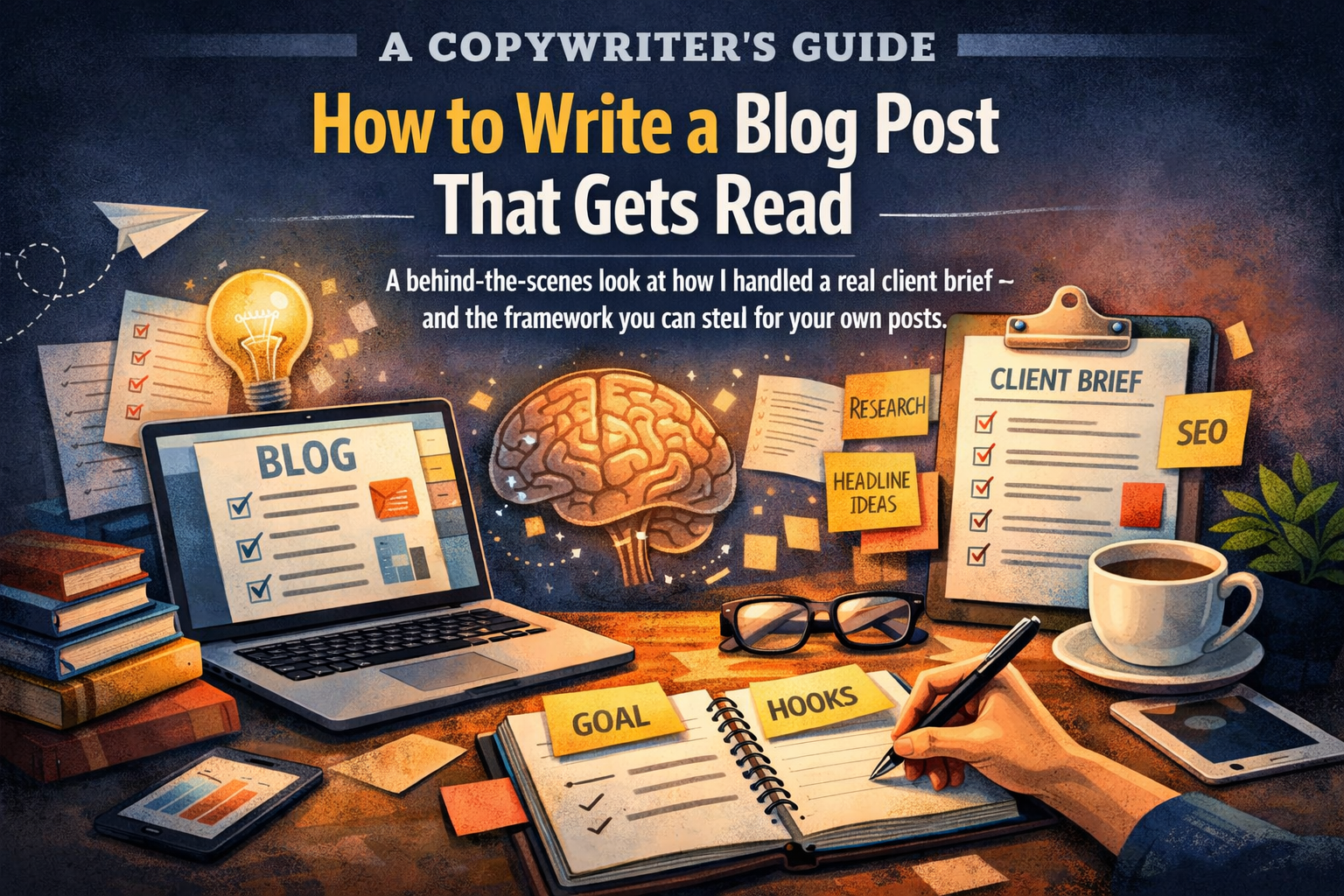
How to Write a Blog Post That Gets Read
A COPYWRITER'S GUIDE
A behind-the-scenes look at how I handled a real client brief – and the framework you can steal for your own posts.
There are thousands of articles online about how to write a blog post. Many cover the same ground, and some can feel a little overwhelming if you're not already deep in the world of digital marketing.
This one is different, or at least, that's my intention. Because instead of giving you theory, I'm going to walk you through a client project – step by step – so you can see exactly how a professional copywriter approaches a blog brief from start to finish.
My client sells nootropic supplements (brain-boosting products, if you're not familiar). They wanted a blog post on natural foods that support brain health. Their brief? Build brand authority and trust. No sales pitch, and quality good enough to appear in a top magazine.
Simple enough on paper. But as with every brief, the real work happens before you write a single word. Here's how I do it – and how you can apply the same thinking to your own content.
Step 1: Understand the Goal Before You Touch the Keyboard
This is often where most people go wrong. They read a brief, see the topic, and immediately start writing. I’d suggest you don't do that.
Before anything else, ask yourself: what is this content supposed to do?
In my client's case, the goal was to build trust and authority. That tells me:
No pushy selling
Science and evidence is what matters here
The tone needs to feel expert but not clinical
The reader should come away feeling informed and impressed, but not sold to
When you understand the job the content needs to do, every decision you make from here on gets easier. Think of it as your north star. When you're unsure whether to include something, come back to the goal and ask: does this serve it?
💡Tip: Always clarify the goal with your client before you start. 'What do you want the reader to do, think or feel after reading this post?' – This one question can save you hours of rewrites.
Step 2: Do Your Research Properly
Want to see this framework in action? Here's the brain foods post I wrote for that client brief
For this project, I needed to know the top six natural brain-boosting foods and the science behind them. So I got busy researching to find out.
Good blog content is built on solid foundations. For a health and wellness brand (in this case, a US-based brand), that means referencing credible studies – the kind published in journals like The American Journal of Clinical Nutrition or Neurology. It's what gives the content authority and keeps it trustworthy.
As I researched, I pulled together key insights: blueberries rich in flavonoids that may support the brain, omega‑3‑rich fatty fish that help build and protect brain cells, eggs packed with choline for memory, dark leafy greens linked with brains that function as if they were up to 11 years younger in some studies, walnuts that are packed with brain‑supporting nutrients, and Lion’s Mane mushrooms that may help support nerve growth factor.
Really good research also means thinking about the reader. What do they already know? What would genuinely surprise or delight them? What would make them say 'I didn't know that' or 'I'm trying that tomorrow'?
💡Tip: Build a swipe file of credible statistics and surprising facts as you research. These can then become your 'hooks' throughout the article.
Step 3: Choose a Title That Does The Heavy Lifting For You
Your title is arguably the most important line you'll write. It determines whether anyone reads what comes after it.
For this project, I had several options to consider:
6 Foods That Hack Your Brain's Natural 'Focus Switch'
6 Elite Brain-Boosting Foods Backed by Science
6 Unusual Brain Foods That Outperform Coffee (Backed by Neuroscience)
The 6-Food Formula High Performers Use to Double Mental Clarity
Notice what each of these does. They don't just describe the article – they sell it. They create curiosity. They promise a specific, tangible outcome. They use numbers (which readers instinctively trust because they signal structure). The best titles do three things: they identify the reader, they promise value, and they create a reason to click right now.
The title I went with for this piece was: '6 Science-Backed Foods That Naturally Boost Your Brain Power (And How to Use Them)'. It's clear, benefit-driven and immediately tells the reader they'll walk away with practical information they can use straight away.
Step 4: Write for People First, Search Engines Second
The relationship between great writing and SEO (Search Engine Optimisation) is not in conflict. Done well, they're really the same thing.
What the Data Tells Us About Blog Posts in 2025
Let's look at some of the numbers:
📊 A large Backlinko study of over 11 million results found that the average first‑page result is around 1,447 words, and multiple analyses suggest many top‑ranking posts fall in the 1,500–2,500 word range.
📊 Semrush’s 2024 Content Trends data indicates that articles over 2,000 words can drive roughly 4× more traffic and around 1.5× more social shares than shorter pieces.
📊 Orbit Media’s long‑running blogger survey shows the average blog post has grown from under 1,000 words in 2014 to around 1,400 words today, an increase of roughly 70%.
📊 Most modern SEO guides suggest aiming for 1,500–2,500 words for in‑depth, authoritative blog content.
Now, before you run off to pad every post to 2,500 words, a word of warning.
Google's own guidelines are explicit: quality content that fully answers the reader's question will always outperform artificially inflated word counts.
So, Google doesn’t reward word count for its own sake. Thin or obviously padded content tends to be de‑prioritised, while in‑depth, genuinely helpful content is rewarded.
For my client's brief, 500 to 800 words was the specified length – a conscious choice to keep it punchy and magazine-style. The lesson? Always match length to context and purpose.
Keywords: Use Them Naturally, But Definitely Not Obsessively
A keyword is simply the phrase your target reader types into Google. For this post, core keywords would include things like 'brain-boosting foods', 'natural foods for memory', and 'foods that improve focus'.
As a practical rule of thumb, aim to include your primary keyword in the title, early in the introduction, in at least one relevant subheading and again near the end. Then weave related terms and natural variations through the body – no stuffing, no robotic repetition. Modern Google cares far more about how well you answer the searcher’s question than how often you repeat a phrase.
What Is Metadata – and Why Does It Matter?
Metadata is the information about your blog post that search engines read, even though readers don't always see it directly. There are two main elements to be aware of:
Meta Title: This is the headline that appears in Google search results. Aim for roughly 50–60 characters so it doesn’t get truncated, put your main keyword near the start, and write it like a tiny ad for your article.
Meta Description: This is the summary that sits beneath your title in search results. It doesn’t directly affect rankings, but it has a big impact on whether someone clicks. Aim for roughly 120–160 characters and write it like a mini pitch – think about what’s in it for the reader?
For this brain food article, a strong meta description might be: “Discover 6 science‑backed foods that sharpen memory, boost focus, and support long‑term brain health. No supplements required.” Short, specific, and benefit‑led!
💡 Tip: Write your meta title and description at the same time as your headline – before you start writing the article. It forces clarity about what the piece is about and who it's for.
Step 5: Structure Your Content for Scanners and Readers
In today’s Internet age, most people scan before they read. They look at the headline, the subheadings, the images, and the first sentence of each section. If what they see looks interesting and easy to navigate, they'll commit and read it properly.
So structure matters enormously. For the brain food article, I used:
A punchy, stat-led introduction to hook the reader immediately
Clear numbered sections (one per food) for easy scanning
A bold subheading within each section (the science, then simple ways to enjoy it)
Brief, accessible explanations of the science
Practical takeaway tips so the reader feels equipped, and not just informed
A warm, forward-looking conclusion that earns trust without selling
Images also play an important role. The brief specified images but no video – smart for a magazine-style piece. Each food got its own beautiful, high-quality image. Visuals break up text, they reinforce the content emotionally, and can significantly improve engagement and time on page. While Google doesn’t list ‘time on page’ as a direct ranking factor, content that keeps people engaged tends to perform better overall.
Step 6: Write With Personality
This is where copywriting separates itself from content writing. Anyone can list facts. Good copywriters make those facts feel interesting, surprising, or meaningful.
In the brain food article, I could have written: 'Walnuts contain omega-3 fatty acids.' Instead, I wrote: 'These brain-shaped nuts really help your brain! A fascinating two‑year study found that people who regularly ate walnuts tended to perform better on cognitive tests and processing speed. ' Same information, but a different reading experience.
Small moments of personality – a well-placed observation, an unexpected comparison, a line that makes the reader smile – are what make people share content and come back for more. They're also what make your writing feel distinctive and helpful to your readers.
Step 7: End With Purpose
Your conclusion should do two things: summarise the value the reader just received, and give them a clear direction for what to do next.
In this piece, the closing paragraphs reinforced the core message – sustainable brain health is built through consistent, smart choices. The reader leaves feeling motivated rather than overwhelmed. No hard sell, just a gentle nudge in the right direction.
If you’re writing for your own business, this is also where a subtle call to action can sit naturally. Not necessarily ‘BUY NOW’, but a next step that builds on what they’ve just learned. For example: ‘Want to learn more about how nutrition and cognitive supplements work together? Explore our guides here.’ Helpful, not pushy.
The Blog Post Checklist: Your Quick Reference
Before you publish anything, run through this:
✅ Clearly define the goal (what should the reader do/feel/think?)
✅ Solid research with credible sources
✅ Title that sells the click – specific, benefit-led, numbered where appropriate
✅ Primary keyword in the title, intro, & at least one subheading, and conclusion
✅ Meta title (50-60 characters) and meta description (120–160 characters)
✅ 1,500–2,500 words for most posts (match to your brief and platform)
✅ Subheadings – have one every 200–300 words for scannability
✅ Include high-quality images that add context
✅ Short paragraphs (2–4 sentences) for readability
✅ Personality – add at least one line that clearly shows your voice
✅ Conclusion that reinforces value and points the reader towards what to do next
Final Thought
Writing a great blog post isn't complicated. But it does require intention. Every decision, from the title to the metadata to the closing line, should serve the reader and the goal.
The brain food article I wrote for my client checks every box. It builds authority through credible science. It earns trust by giving genuinely useful information for free. It reflects the brand's values without ever feeling like an advertisement. And it's structured in a way that works for scanners, readers, and search engines alike.
That's the standard to aim for.
I hope you found this useful 😃